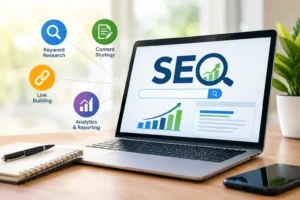
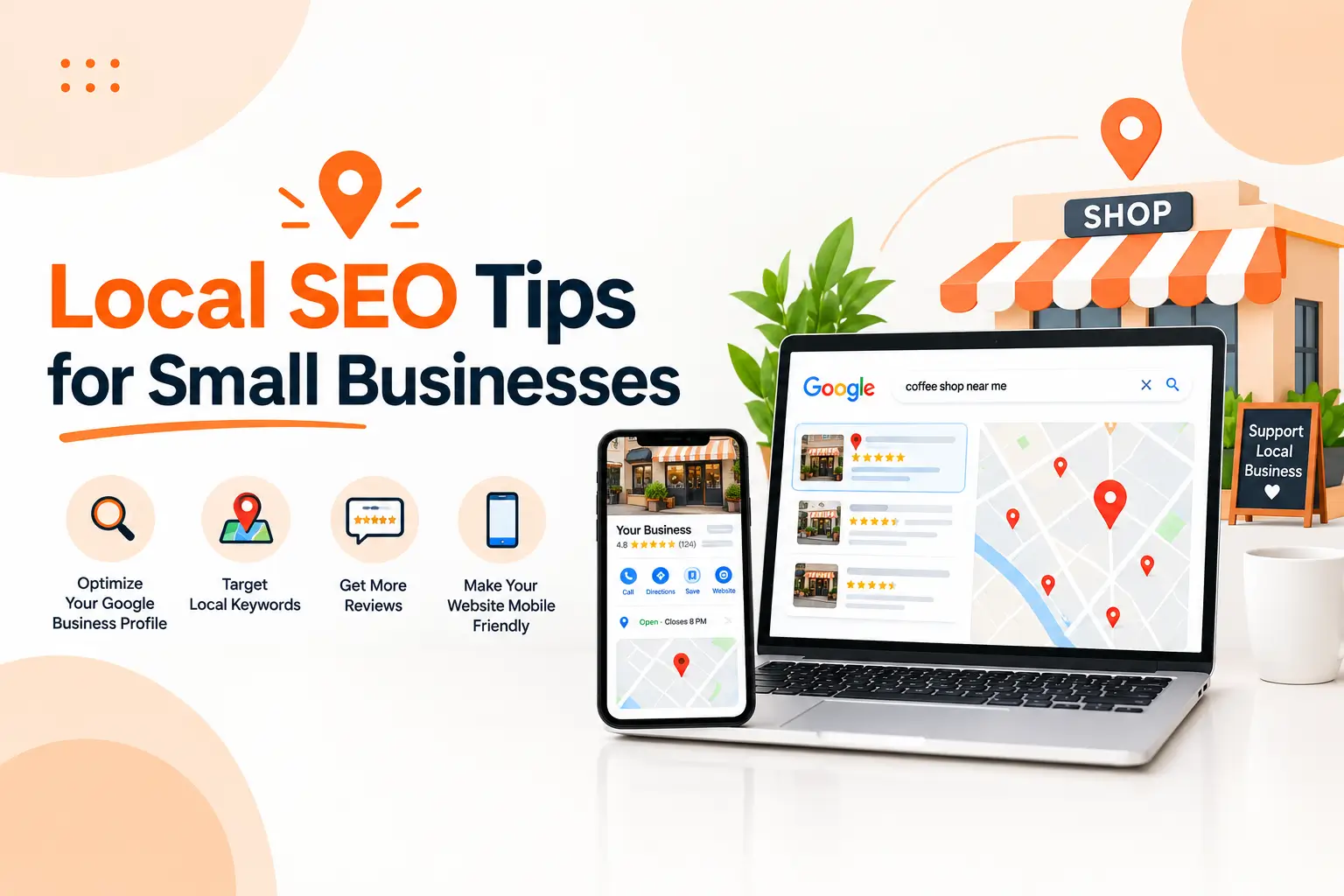
Local SEO tips small businesses reach more customers in their area. Start by creating and updating your Google Business Profile with the correct business name, address, phone number, working hours, and services. Add clear photos and encourage happy customers to leave honest reviews. Use local keywords on your website to help search engines understand your services and location. Keep your contact details consistent across online directories. Create helpful content that answers common customer questions and make sure your website works well on mobile devices. Regular updates can improve your online presence and help people find your business. For professional support, explore SEO services from Amigos IT Systems to improve your local search visibility and attract potential customers.
Why Local SEO Tips Small Businesses Are Important
People searching for a local business usually want to buy soon. Not next month. Today, often within the hour. A person who searches “pharmacy open now” isn’t browsing for fun, they’ve got a sick kid at home. Local SEO puts your name in front of that person at the exact moment they’re ready to spend. And here’s the part most owners miss: your website is where a lot of those searchers end up before they call, so if it looks like it was built in 2012, they’ll quietly go back and pick someone else. A fresh site from our website development team fixes that.
It’s also cheaper than ads in the long run. Ads stop the day you stop paying. Good rankings stick around, especially when you back them with social media marketing and clean, eye-catching visuals from graphic designing.
How to Optimize Your Google Business Profile
This is the single step from this entire list that you must take up. Your Google Business Profile will be displayed on Google Maps and in the information section on the right-hand side of the search results. And the best part is that it’s free. Therefore, you need to claim and verify it and also do not forget to fill every section, including the boring ones like the operating areas and working hours on public holidays. Choose the most suitable main category, as a pizza restaurant certainly ranks better than just a restaurant. While uploading your photos, use real photos of your restaurant instead of stock photographs. However blurry your own photo of the front of your restaurant may be, it is still better than a perfect stock picture. In addition, make sure to post an offer or a last-minute deal once a week or biweekly. Google’s own guide on how to improve your local ranking says relevance, distance and prominence matter most, and a complete profile helps with all of them.
Conduct Local Keyword Research to Reach Nearby Customers
Keywords are just the words your customers type. Simple as that. The trick with local SEO is adding a place name: “bridal makeup in Johar Town” instead of only “bridal makeup”. Start by typing your service into Google and watching what it suggests. Those suggestions come from real searches, so they’re gold. Google Keyword Planner is free too, though it can feel clunky the first time you use it. Also, talk to your staff. Ask the person who answers your phone what words customers actually use. You’ll be surprised. One clinic we worked with found people searching for “skin doctor” far more than “dermatologist”, and they’d been using the wrong word on their site for three years.
Optimize Your Website for Local Search
Your website needs to tell Google, clearly, where you are. Put your city and area name in your page titles and main headings. Mention it naturally in the first paragraph of your home page too. Don’t overdo it, though. Writing “best plumber Lahore” eleven times on one page just looks spammy, and Google knows it. Add your full address and phone number to the footer so it shows on every page. Embed a Google Map on your contact page. It’s a small thing, but it helps both visitors and search engines. If you’ve got a physical shop, mention a nearby landmark, like “opposite Emporium Mall”. People actually find that useful when they’re trying to reach you.
Create Location-Specific Landing Pages
Does your organization provide services in more than one locality? If yes, then a single page won’t serve the purpose anymore. You should create a separate page for every locality that you serve. For instance, a cleaning business may have one webpage for DHA Phase 5 and another page for Bahria Town. The mistake that many businesses make is that they take the same content and replace just the locality name. However, Google’s bots quickly discover such practices and downgrade such pages. To make things right, you need to create unique content for every area. You may discuss some work performed in an area, present a testimonial of a local customer, or explain a local situation that is typical for this locality.
Keep Your Business Name, Address, and Phone Number Consistent
SEO people call this NAP (name, address, phone). It sounds boring, and it kind of is, but it matters a lot. Your details should match exactly on your website, Google profile, Facebook page, and every directory you’re listed on. Even small changes cause trouble. “Shop #4, Main Boulevard” on one site and “Shop 4, Main Blvd” on another can make Google unsure whether they’re the same business. Moved office last year? Then there’s a good chance an old address is still sitting in some forgotten directory. Spend one afternoon searching your business name, make a list of every listing you find, and fix them one by one. Boring afternoon, better rankings.
Get More Customer Reviews to Improve Local Visibility
They help you rank, and they help strangers trust you. Most happy customers won’t leave a review on their own, not because they don’t like you, they just forget. So ask. The best moment is right after a good experience, when they’re smiling at the counter or just thanked you on WhatsApp. Send them your direct review link so it takes ten seconds, not five minutes. Reply to every review. Yes, the angry ones too. A calm, polite reply to a one-star review often impresses new customers more than ten five-star ones do. And please, don’t buy fake reviews. Google removes them, and sometimes it suspends the whole profile.
Build Local Backlinks to Strengthen Your SEO
A backlink is defined as a link coming from another site to yours. You can picture it as someone putting in a good word for you. When links from local businesses are pointed to your site, Google spots you as a legitimate and reliable member of the local community. Where to acquire backlinks? Start by searching in business directories or at the chamber of commerce in your town. Take part in events at schools and charities. You may find sponsors listed on their sites. Seek for partnership with businesses catering to the same target audience, yet not in competition with you, for example, a bridal photographer and wedding salon. Also, try to get featured in the local press or on blogs if you have an interesting story to share.
Create Local Content That Attracts Your Target Audience
Blog posts don’t have to be about your products. In fact, they work better when they aren’t. Write about things your local customers already care about. A car workshop in Karachi could write “How to protect your car during the monsoon season”. A bakery might share “Where to find the best Eid sweets in Lahore”, and it’s okay to mention a few spots that aren’t yours. People trust that. Local event guides, area news, and answers to questions your customers keep asking all work well. This kind of content pulls in nearby readers and quietly tells Google that you know your area. Post regularly, even if it’s just twice a month.
Optimize Your Website for Mobile Users
Most local searches happen on phones. Someone stuck in traffic on Shahrah-e-Faisal isn’t opening a laptop to find a tyre shop. So your website has to work well on a small screen, full stop. Text should be easy to read without pinching and zooming. Buttons need to be big enough for a thumb. Add a “tap to call” button and a WhatsApp button near the top, because that’s what most mobile visitors want to do anyway. Test your site on your own phone, and on an older, cheaper phone too if you can borrow one. Things that look fine on a new iPhone can look broken on a three-year-old Android.
Use Local Business Schema Markup
This one sounds technical. It isn’t that scary. Schema markup is a small piece of hidden code on your website that tells search engines clear facts about your business: your name, address, phone number, opening hours, price range, and even your star rating. Visitors never see it, but Google reads it and understands your business better. Sometimes it also makes your search listing look richer, with stars or hours showing right there in the results. Pick “LocalBusiness” or a more specific type, like “Dentist” or “AutoRepair”. If you use WordPress, plugins like Rank Math or Yoast can add it for you. Otherwise, your web developer can usually set it up in under an hour.
Improve Your Website Speed and User Experience
Slow websites lose customers. People won’t wait eight seconds for your page to load, they’ll hit the back button and call your competitor. Start with images; most small business sites we audit have photos that are five or six times bigger than they need to be. Compress them. Use decent hosting rather than the cheapest plan you can find. Remove plugins you installed once and forgot about. Then think about the visitor. Can they find your prices, services and phone number within a few seconds? If not, simplify your menu. Run your site through Google PageSpeed Insights. It’s free, it shows a score, and it tells you exactly what’s slowing you down.
Track Your Local SEO Performance
Measuring is the first step in improving. Google Business Profile indicates how many times a prospective customer visited your website, found directions to your location, or gave you a phone call. Check it at least once a month, preferably on the first Monday of the month, so that you build a habit. Google Search Console reveals what search queries bring users to your site, in which position you appear for a certain search query. Google Analytics helps you see what your visitors do at your site. Don’t get lost in all the numbers – pick the 3 or 4 most important of them to your business and analyze those numbers.
Common Local SEO Mistakes to Avoid
We see the same mistakes over and over. Some are small, some quietly kill your rankings for months. Watch out for these:
- Setting up a Google Business Profile and then never touching it again.
- Using different phone numbers on different websites (a personal mobile here, an office landline there).
- Ignoring reviews, or worse, arguing with customers in the replies.
- Stuffing city names into every sentence until the page reads like a robot wrote it.
- Using a P.O. box or virtual office address, which can get your profile suspended.
- Forgetting about mobile users completely.
Most of these take less than a day to fix. The trouble is that nobody notices them until rankings have already dropped.
Final Thoughts
Local SEO isn’t magic, and it’s not a one-time job either. It’s more like keeping a shop clean. A little effort every week beats a big push once a year. Start with your Google Business Profile this week. Next week, fix your NAP details. After that, ask your five happiest customers for a review. You’ll start to see small changes within a couple of months, and they add up. Rankings take a while to build, but once they’re there, they bring in customers day after day. If you’d like a team that handles all of this for you, contact us and we’ll take a look at where your business stands right now.
Frequently Asked Questions
1. What is local SEO in simple words?
It’s the work you do so people near you can find your business on Google Search and Google Maps. Think “near me” searches.
2. Is Google Business Profile free?
Yes, completely free. You need a Google account and a real address or service area. Verification can take a few days, sometimes a couple of weeks.
3. How long does local SEO take to show results?
Most businesses notice small improvements within one to three months. Bigger, steadier results usually show up after four to six months of regular work.
4. How can I get more Google reviews?
Ask right after a good experience and send your direct review link on WhatsApp or SMS. The easier you make it, the more people will actually do it.
5. Do I need a website for local SEO?
You can show up on Google Maps with just a Business Profile. But a good website helps you rank for many more searches and makes people trust you faster.